
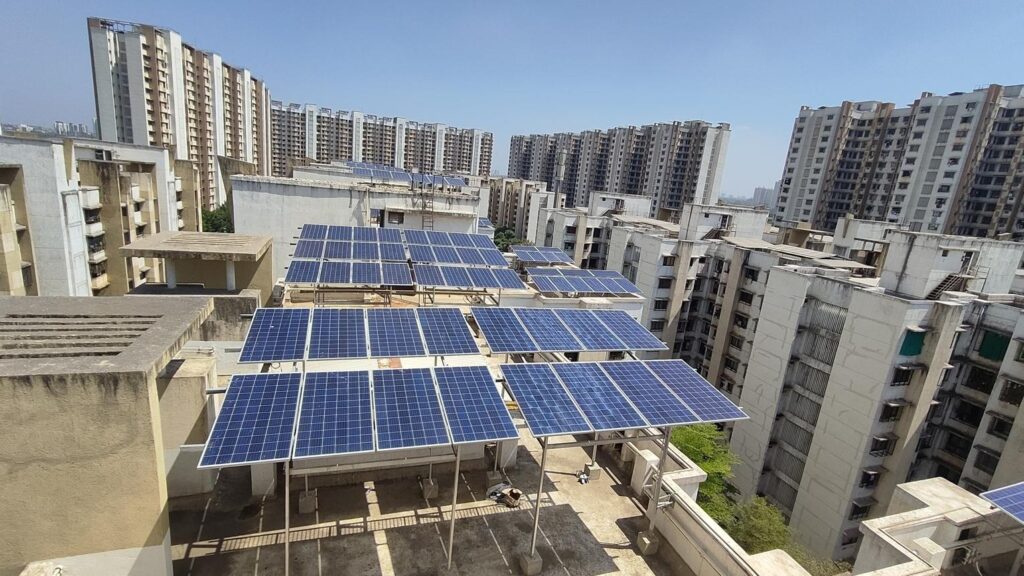
Electricity consumption is a major recurring expense for housing societies across Mumbai, Thane and Navi Mumbai. From lifts and water pumps to corridor lighting, parking lights, security systems and other common facilities, residential buildings require a continuous supply of electricity to manage their daily operations.
With increasing interest in renewable energy, many housing societies are exploring Rooftop Solar Installation in Mumbai as a way to generate electricity and potentially reduce common-area electricity expenses.
A properly planned rooftop solar system can help residential buildings utilise unused terrace space, generate clean electricity and manage a portion of their common electricity requirements.
However, installing solar panels in a housing society involves more than selecting solar equipment. Societies need to evaluate rooftop availability, electricity consumption, structural suitability, system capacity, electrical infrastructure, net metering arrangements, permissions and long-term maintenance.
In this guide, Galvanic Engineers explains everything housing societies should understand before planning rooftop solar installation in Mumbai, including the installation process, benefits, costs, technical requirements and important considerations.
What Is Rooftop Solar Installation for Housing Societies?
Rooftop solar installation is the process of installing solar photovoltaic (PV) panels on a building’s rooftop to generate electricity from sunlight.
For housing societies, the electricity generated can be used to support common facilities such as:
- Elevators and lifts.
- Water pumps and motors.
- Common-area lighting.
- Staircase and corridor lighting.
- Parking-area lighting.
- Security systems.
- Clubhouse facilities.
- Other shared electrical equipment.
Instead of relying entirely on electricity purchased from the distribution company, the society can use solar-generated electricity to meet eligible portions of its common electricity demand.
Depending on the approved system configuration and applicable regulations, excess electricity may also be exported to the electricity grid under an eligible metering arrangement.
Rooftop Solar for Housing Societies in Mumbai is therefore worth evaluating for residential buildings with suitable rooftop space and consistent common-area electricity consumption.
Why Are Housing Societies in Mumbai Installing Rooftop Solar Panels?
Housing societies are increasingly exploring solar energy because it offers an opportunity to manage electricity consumption while making better use of available rooftop space.
Here are some important benefits.
1. Potential Reduction in Common-Area Electricity Bills
One of the main reasons housing societies consider solar panel installation is the potential reduction in electricity expenses.
Common facilities such as lifts, water pumps, parking lights and corridor lighting consume electricity throughout the month.
A properly sized solar system can generate electricity to offset a portion of this consumption, depending on the generation profile, tariff structure and applicable metering arrangement.
The actual savings depend on system capacity, rooftop conditions, electricity consumption patterns, solar generation and utility billing provisions.
2. Make Better Use of Available Rooftop Space
Many apartment buildings have unused terrace areas that receive sufficient sunlight.
With proper planning, a portion of this space can be utilised for installing solar panels.
Before installation, the society should evaluate rooftop accessibility, structural suitability, water tanks, overhead equipment, shading and maintenance access.
3. Reduce Dependence on Conventional Electricity
Solar panels generate electricity using renewable energy from sunlight.
By using solar power for common facilities, a housing society can reduce the amount of electricity it needs to purchase from the grid during suitable generation periods.
However, a grid-connected rooftop solar system does not automatically provide backup during a power outage. Backup capability requires an appropriately designed battery or other backup arrangement.
4. Support Environmental Sustainability
Solar energy is a renewable source of electricity that can help reduce reliance on conventional grid electricity.
Housing societies adopting rooftop solar can support their sustainability objectives and encourage residents to consider cleaner energy solutions.
5. Long-Term Energy Planning
A rooftop solar system is a long-term infrastructure investment.
With suitable equipment, proper installation and regular maintenance, societies can plan their energy requirements over an extended period.
The investment should be evaluated using the expected electricity generation, project cost, operating expenses, equipment warranties and applicable utility arrangements.
Which Common Facilities Can Use Rooftop Solar Electricity?
Before deciding the system capacity, a housing society should identify which electrical loads it wants to support.
Common facilities that may be considered include:
| Common Facility | Solar Electricity Application |
| Elevators | Supporting lift electricity consumption |
| Water Pumps | Supplying electricity to water pumping systems |
| Corridor Lighting | Supporting common-area lighting |
| Staircase Lighting | Reducing grid electricity consumption |
| Parking Lighting | Supporting parking-area illumination |
| Security Systems | Supplying electricity to eligible security equipment |
| Clubhouse | Supporting selected common electrical loads |
| Society Office | Supporting office equipment and lighting |
The final electrical arrangement depends on the society’s existing distribution system and approved solar connection design.
A solar consultant should assess the society’s actual electricity consumption before recommending a system.
How Much Rooftop Solar Capacity Does a Housing Society Need?
One of the first questions society committees ask is:
How many solar panels or how much solar capacity should we install?
The answer depends on the building’s common-area electricity consumption, available rooftop space, sunlight conditions and electricity connection arrangements.
The system should be sized according to the society’s actual requirements rather than simply installing the maximum number of panels that fit on the rooftop.
Step 1: Review Monthly Common-Area Electricity Consumption
Collect the electricity bills for the society’s common-area connection.
Review the consumption over the previous 12 months to understand seasonal variations and average monthly electricity usage.
For example:
| Month | Common-Area Consumption |
| January | 5,200 units |
| February | 4,900 units |
| March | 5,100 units |
| April | 5,600 units |
| May | 6,000 units |
| June | 5,800 units |
These are illustrative figures.
The actual assessment should include the society’s complete consumption pattern, applicable tariff and daytime electricity usage.
Step 2: Evaluate Available Rooftop Space
The next step is to assess how much rooftop space can be used for solar panel installation.
The assessment should consider:
- Total usable terrace area.
- Existing water tanks.
- Overhead structures.
- Nearby buildings and shading.
- Solar panel orientation.
- Maintenance pathways.
- Structural load capacity.
- Wind and weather exposure.
Not every square foot of terrace space can necessarily accommodate solar panels.
Step 3: Estimate Solar Generation
Solar generation depends on the installed capacity, location, sunlight availability, panel orientation, shading, inverter performance and system losses.
For example, consider an illustrative 25 kW rooftop solar system.
If the system generates an average of 100 units per day:
100 units × 30 days = 3,000 units per month.
This is an example for explaining the calculation, not a guaranteed generation estimate.
Actual generation should be estimated using the site’s solar conditions and a technical feasibility assessment.
Step 4: Match System Capacity with Electricity Requirements
After reviewing consumption and expected generation, the society can identify a suitable solar system capacity.
A properly sized system should consider:
- Monthly electricity consumption.
- Daytime common-area load.
- Available rooftop space.
- Electricity tariff.
- Metering arrangement.
- Distribution transformer capacity.
- Applicable grid connectivity requirements.
- Future expansion plans.
Types of Rooftop Solar Systems for Housing Societies
Housing societies can evaluate different solar system configurations depending on their electricity requirements and backup expectations.
1. On-Grid Solar System
An on-grid solar system is connected to the electricity distribution network.
Solar panels generate electricity during daylight hours, and the connected building loads use the generated electricity according to the system design.
Where permitted and approved, excess electricity may be exported to the grid under an applicable net metering or other approved arrangement.
Benefits of an On-Grid Solar System:
- Can offset common-area electricity consumption.
- Generally does not require battery storage.
- Suitable for buildings with regular daytime electricity demand.
- Can be integrated with an approved metering arrangement.
- Requires less battery-related maintenance than a battery-based system.
Important: Conventional grid-connected inverters generally shut down during a grid outage for safety reasons. An on-grid system without an appropriate backup arrangement will not automatically supply electricity during a power cut.
2. Off-Grid Solar System
An off-grid solar system operates independently of the electricity grid and generally uses batteries to store electricity.
The system may be considered where backup electricity is required and a suitable grid-connected arrangement is unavailable or not preferred.
Benefits of an Off-Grid Solar System:
- Can supply selected electrical loads without grid availability.
- Supports battery-based energy storage.
- Can be designed for specific backup requirements.
- May be useful for selected independent applications.
However, battery capacity, replacement costs, maintenance and system design must be evaluated carefully.
3. Hybrid Solar System
A hybrid solar system combines solar generation, grid connectivity and battery storage.
Depending on the design, it can use solar energy, store electricity in batteries and draw electricity from the grid when required.
Benefits of a Hybrid Solar System:
- Supports solar electricity generation.
- Can provide backup to selected loads.
- Allows energy storage.
- Offers flexibility in electricity management.
The cost and complexity are generally higher than a basic grid-connected system.
Which Solar System Is Best for Housing Societies?
| System Type | Main Purpose | Battery Required | Suitable Application |
| On-Grid | Reduce grid electricity consumption | Generally No | Common-area electricity |
| Off-Grid | Independent electricity supply | Yes | Selected backup applications |
| Hybrid | Solar generation with backup | Usually Yes | Common loads requiring backup |
For many housing societies looking to offset common-area electricity consumption, an on-grid system may be worth evaluating first.
The final selection should depend on the society’s electricity requirements and technical feasibility.
Step-by-Step Process for Rooftop Solar Installation in Housing Societies
Installing solar panels in a residential society requires coordination between the managing committee, residents, solar installer and electricity distribution company.
Here is a general installation process.
Step 1: Conduct a Solar Site Survey
The first step is to inspect the building’s rooftop and electrical infrastructure.
The site survey should evaluate:
- Available rooftop space.
- Solar exposure and shading.
- Existing electrical panels.
- Common-area electricity consumption.
- Structural suitability.
- Cable routing possibilities.
- Inverter installation location.
This helps determine whether the proposed rooftop solar system is technically suitable.
Step 2: Calculate the Required Solar Capacity
After the survey, the solar capacity can be estimated based on the society’s electricity consumption and available rooftop area.
For example, if the society consumes approximately 3,000 electricity units per month for common facilities, the solar system can be planned to offset a suitable portion of this demand.
The actual capacity should be determined after considering local solar generation, losses and utility requirements.
Step 3: Obtain Society Approval
Since the rooftop is generally a shared building facility, the housing society should follow its applicable internal approval process.
The managing committee should discuss:
- Project cost.
- Funding arrangements.
- Expected electricity savings.
- Rooftop usage.
- Installation responsibilities.
- Maintenance arrangements.
- Metering and billing.
- Warranty and service conditions.
Any required general body approval, permissions or resolutions should be obtained in accordance with applicable society rules and legal requirements.
Step 4: Apply for Solar Connectivity and Feasibility
The next step is to initiate the applicable rooftop solar connectivity application with the relevant electricity distribution company.
For eligible MSEDCL consumers, the rooftop solar process is handled through its official solar application system.
The application process generally involves submitting consumer details, selecting the applicable metering arrangement and obtaining technical feasibility assessment.
The exact procedure differs depending on the distribution licensee serving the building.
Step 5: Select Solar Panels and Equipment
After confirming the project requirements, the society can finalise the solar equipment.
Important components include:
- Solar PV panels.
- Grid-connected or hybrid inverter.
- Mounting structures.
- DC and AC cables.
- Electrical protection devices.
- Earthing arrangements.
- Solar generation monitoring equipment.
- Metering equipment, as applicable.
Equipment should meet the applicable technical and quality requirements.
Step 6: Complete Solar Panel Installation
Once the necessary approvals and preparations are completed, installation can begin.
Typical activities include:
- Preparing the rooftop installation area.
- Installing the mounting structures.
- Fixing solar panels.
- Installing the inverter.
- Laying DC and AC cables.
- Installing required protection systems.
- Connecting the solar system to the building’s electrical installation.
The installation should be completed by qualified personnel according to the approved design and applicable safety requirements.
Step 7: Inspection, Testing and Commissioning
After installation, the system should undergo the required technical checks.
These may include:
- Solar panel inspection.
- Electrical connection verification.
- Earthing and protection checks.
- Inverter configuration.
- Grid synchronisation.
- Metering verification.
- Utility inspection, where applicable.
The system should be connected to the electricity distribution network only after the required approvals and commissioning formalities have been completed.
Step 8: Monitor Solar Generation and Maintain the System
After commissioning, the society should monitor electricity generation and system performance.
Regular maintenance helps identify problems such as dust accumulation, damaged cables, inverter faults and reduced generation.
Net Metering for Housing Societies in Maharashtra
Net metering is an important consideration when planning rooftop solar installation.
Under an approved net metering arrangement, eligible solar electricity generated by the consumer can be used to offset electricity consumption, while surplus generation may be exported to the electricity distribution network according to the applicable regulations.
For housing societies, this can be particularly relevant when solar electricity is installed for common facilities.
How Does Net Metering Work?
A simplified example:
- Solar panels generate electricity during daylight hours.
- The society uses solar electricity for common facilities.
- If generation exceeds the building’s consumption at a particular time, surplus electricity may be exported to the grid under the approved arrangement.
- Electricity imported from and exported to the grid is measured through the approved metering system.
- Billing is calculated according to the applicable tariff and metering regulations.
The actual treatment of exported energy, credits and settlement depends on the approved arrangement and applicable regulations.
What Is Virtual Net Metering?
Virtual net metering can be relevant to residential consumers who want to share the benefits of a renewable energy system located at a common or different eligible location.
Under the Maharashtra regulatory framework, virtual net metering and group net metering provisions have been addressed through amendments to the rooftop renewable energy regulations.
This can create additional possibilities for residential consumers in multi-storey buildings and group housing arrangements.
However, eligibility, participating consumers, system capacity, location, allocation and billing conditions must be verified under the current MERC regulations and the relevant distribution licensee’s procedure.
For societies considering a shared solar project, this is an important subject to discuss with the electricity distribution company before finalising the investment.
Important Permissions and Documents for Housing Society Solar Installation
Before starting a rooftop solar project, the society should prepare the required documentation.
The exact requirements depend on the distribution company, connection type, solar system capacity and metering arrangement.
The following is a general preparation checklist.
| Document / Requirement | Purpose |
| Latest common-area electricity bill | Verify the existing electricity connection |
| Consumer number | Identify the electricity account |
| Society registration certificate | Verify the housing society |
| Society resolution or approval | Document internal project approval, where required |
| Authorisation letter | Authorise the representative submitting the application |
| Rooftop ownership or usage details | Establish the society’s rights to use the installation area |
| Proposed solar system capacity | Define the planned generation capacity |
| Solar panel and inverter specifications | Provide technical equipment details |
| Electrical single-line diagram | Show the proposed electrical connection |
| Structural assessment | Evaluate rooftop suitability, where required |
| Solar installation drawings | Explain the proposed panel layout |
| Metering application and agreement | Complete the applicable utility formalities |
The electricity distribution company may request additional documents or technical information during the application and inspection process.
What Is the Cost of Rooftop Solar Installation for Housing Societies in Mumbai?
The cost of rooftop solar installation depends on the system capacity, equipment quality, rooftop conditions, electrical infrastructure and installation complexity.
There is no single fixed price applicable to every housing society.
The main project cost components include:
| Cost Component | Factors Affecting Cost |
| Solar Panels | Capacity, technology, brand and specifications |
| Solar Inverter | Type, capacity and technical features |
| Mounting Structure | Rooftop design, height and material |
| Electrical Cables | Cable size, distance and routing |
| Protection Equipment | Required electrical safety devices |
| Earthing System | Number and type of earthing arrangements |
| Civil Work | Foundation, drilling and rooftop modifications |
| Metering | Applicable metering and connection requirements |
| Installation | Labour and project complexity |
| Monitoring | Generation monitoring and communication equipment |
Factors That Can Increase Solar Installation Costs
- Limited rooftop accessibility.
- Complex rooftop structure.
- Long cable routes.
- Additional electrical panel modifications.
- Structural reinforcement, if required.
- Higher-capacity inverters.
- Battery storage.
- Additional safety equipment.
A professional site assessment is recommended before comparing quotations from different solar installation companies.
Is Solar Installation Eligible for Government Subsidy?
Housing societies should distinguish between a solar system installed for common facilities and individual residential rooftop solar systems.
Under the PM Surya Ghar: Muft Bijli Yojana framework, group housing societies and residential welfare associations may be eligible for central financial assistance for common facilities, subject to the scheme’s applicable capacity limits, eligibility requirements and current implementation guidelines.
MSEDCL’s official I-SMART information describes assistance for eligible group housing societies and residential welfare associations for common facilities, subject to scheme conditions.
The availability and amount of assistance should be verified through the official scheme portal before preparing the project’s financial calculations.
Do not assume that every commercial or common-area solar installation qualifies for residential subsidies.
Important Considerations Before Installing Solar Panels on a Housing Society Rooftop
Before investing in a solar project, the managing committee should evaluate several important factors.
1. Structural Strength of the Rooftop
Solar panels and mounting structures add weight to the building’s rooftop.
The structural suitability of the terrace should be assessed by an appropriately qualified professional, particularly for older buildings.
2. Rooftop Shading
Nearby buildings, water tanks, overhead structures and other obstructions can reduce solar generation.
A proper site survey should evaluate shading patterns and identify suitable installation locations.
3. Waterproofing and Roof Protection
Solar mounting structures should be installed without compromising the building’s waterproofing arrangements.
Installation methods should be selected carefully to minimise the risk of water leakage.
4. Maintenance Access
The society should maintain sufficient space for cleaning, inspection and servicing.
Panels should not block access to water tanks, electrical equipment or other essential rooftop facilities.
5. Electrical Infrastructure Compatibility
The building’s electrical panels, cables, protection equipment and earthing system should be assessed before solar integration.
Any required electrical upgrades should be included in the project proposal.
6. Solar Equipment Quality
Compare the technical specifications, product warranties, inverter performance and service support offered by different vendors.
Avoid selecting equipment only because it has the lowest initial price.
7. Operation and Maintenance
Solar panels require periodic cleaning and system inspections.
The society should understand the maintenance responsibilities, service charges and warranty conditions before finalising the installer.
8. Future EV Charging Requirements
Some housing societies may also plan to introduce EV charging facilities in their parking areas.
When designing rooftop solar and electrical infrastructure, it can be useful to consider future EV charging requirements.
However, solar generation and EV charging demand must be evaluated together. The solar system should not be assumed to supply all EV charging needs without suitable capacity, distribution and energy management planning.
Common Mistakes Housing Societies Should Avoid
1. Installing Solar Panels Without Checking Rooftop Suitability
A rooftop may appear large enough but could have structural limitations, shading or access restrictions.
A technical assessment should be completed before finalising the system.
2. Choosing Solar Capacity Without Reviewing Electricity Bills
Installing a system based only on available rooftop space may result in a mismatch between electricity generation and actual consumption.
Review common-area electricity bills before deciding the capacity.
3. Ignoring Net Metering Requirements
The society should understand the applicable metering and billing arrangement before purchasing solar equipment.
4. Comparing Quotations Only on Price
Low-cost quotations may exclude important equipment, protection arrangements, civil work or maintenance.
Compare the complete technical and commercial scope.
5. Not Considering Future Expansion
The society may need additional electricity for lifts, EV chargers, pumps or other common facilities in the future.
Future electrical requirements should be considered during the planning stage.
6. Ignoring Maintenance and Warranty Conditions
A solar system is a long-term investment. Societies should review equipment warranties, workmanship guarantees and maintenance responsibilities.
How Galvanic Engineers Helps with Rooftop Solar Installation in Mumbai & Thane
Installing rooftop solar panels in a housing society requires proper coordination between electrical assessment, rooftop planning, equipment selection, utility connectivity and commissioning.
Galvanic Engineers provides electrical contracting, solar installation and electrical consultancy solutions for residential and commercial properties across Mumbai, Thane and Navi Mumbai.
Our solar and electrical services include:
- Residential Rooftop Solar Installation.
- Commercial Solar Panel Installation.
- Solar System Planning and Consultancy.
- Rooftop Solar Site Assessment.
- Electrical Load Assessment.
- Solar Electrical Infrastructure Planning.
- Meter Installation Assistance.
- Electricity Connection Assistance.
- Electrical Liaisoning and Utility Coordination.
- EV Charging and Smart Energy Solutions.
Whether your society is planning solar panels for lifts, water pumps, common-area lighting or other shared facilities, our team can help assess the electrical requirements and explore a suitable installation approach.
We also provide electrical solutions for new electricity connections, load enhancement, EV meter installation and electrical consultancy.
Looking for professional Rooftop Solar Installation in Mumbai or Thane?
Contact Galvanic Engineers to discuss your housing society’s electricity consumption, rooftop availability and solar installation requirements.
Visit our website: https://galvanicengineers.com/
Frequently Asked Questions About Rooftop Solar for Housing Societies
1. Can a housing society install rooftop solar panels in Mumbai?
Yes. Eligible housing societies can install rooftop solar systems for common electricity requirements, subject to applicable electricity regulations, rooftop suitability, utility connectivity requirements and necessary society approvals.
2. How much solar capacity does a housing society need?
The required solar capacity depends on the society’s common-area electricity consumption, available rooftop space, sunlight conditions and electricity connection arrangements. A site survey and consumption assessment should be completed before selecting the system size.
3. Can solar panels power society lifts and water pumps?
Yes, solar electricity can be used to support lifts, water pumps and other eligible common-area electrical loads when the system is appropriately designed and connected to the building’s electrical distribution arrangement.
4. Does rooftop solar reduce housing society electricity bills?
A properly sized rooftop solar system can potentially reduce electricity expenses by offsetting a portion of the society’s grid electricity consumption. Actual savings depend on solar generation, common-area demand, tariff structure and applicable metering rules.
5. What is net metering for housing society solar systems?
Net metering is an approved electricity metering arrangement that records electricity imported from and exported to the grid. The billing treatment of these units is governed by the applicable electricity regulations and the distribution licensee’s procedures.
6. Can a housing society share solar electricity among individual flats?
Depending on the applicable regulatory framework and approved arrangement, group net metering or virtual net metering may provide options for allocating solar generation benefits among eligible consumers. The society should confirm current eligibility and procedures with the relevant distribution company.
7. Is structural approval required before installing rooftop solar panels?
The rooftop’s structural suitability should be evaluated before installation. Depending on the building and project conditions, a structural assessment and other necessary permissions may be required.
8. What documents are required for housing society solar installation?
Commonly required documents may include the society registration certificate, electricity bill, consumer number, authorisation documents, society approval, proposed system details, electrical drawings and metering application documents. The final list depends on the distribution company and project.
9. Are government subsidies available for housing society solar installation?
Eligible group housing societies and residential welfare associations may qualify for central financial assistance for common facilities under the applicable PM Surya Ghar scheme provisions. Eligibility, capacity limits and assistance should be checked against current official guidelines.
10. Who provides rooftop solar installation services in Mumbai and Thane?
Galvanic Engineers provides solar installation, electrical consultancy, load assessment and electrical infrastructure solutions for residential and commercial properties across Mumbai, Thane and Navi Mumbai.
Conclusion
Rooftop solar installation can be a valuable long-term energy solution for housing societies in Mumbai, particularly those with suitable terrace space and regular common-area electricity consumption.
However, successful installation requires careful planning. Societies should review their electricity bills, evaluate rooftop suitability, calculate the required solar capacity, understand metering arrangements and verify the electrical infrastructure before investing.
With the right system design, suitable equipment and regular maintenance, a housing society can make better use of its rooftop space while supporting its common electricity requirements.
If your housing society is planning Rooftop Solar Installation in Mumbai, Thane or Navi Mumbai, connect with Galvanic Engineers for professional electrical consultancy and solar energy solutions.